

Author: Coco James
A comparative study based on seven independent sources covering the fundamentals, best practices, and evolving standards of technical SEO.

Definition and Scope
Technical SEO refers to the practice of optimizing a website’s infrastructure — as opposed to its content or external promotion — so that search engines can efficiently crawl, index, and rank its pages. It sits alongside two other pillars of SEO:
- On-Page SEO — content quality, keyword usage, metadata, and user-facing elements.
- Off-Page SEO — backlinks, brand mentions, and external authority signals.
- Technical SEO — site architecture, speed, security, and crawlability; the structural layer that makes the other two possible.
A useful analogy found across the research: technical SEO is the “engine” of a website. A page can have excellent content and strong backlinks, but if search engines cannot access or interpret it correctly, none of that matters. Technical SEO is therefore best understood as a precondition for ranking, not a ranking strategy in itself.
One source distilled it precisely as the set of measurable metrics affecting search rankings that are within the control of developers, programmers, and infrastructure managers — distinguishing it clearly from copywriting or link-building work.
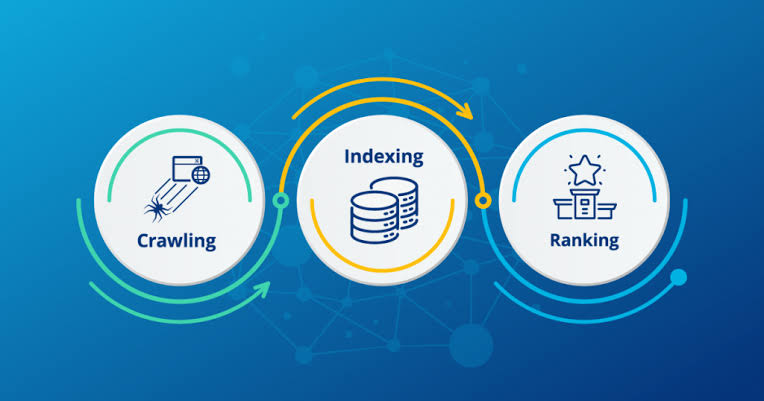
The Two Core Mechanics: Crawling and Indexing
Every source anchors technical SEO around two sequential processes:
| Process | What Happens | Why It Matters |
| Crawling | Search engine bots (“spiders”) follow internal and external links to discover pages | If a page isn’t linked anywhere, it may never be found |
| Indexing | Discovered pages are analyzed and stored in the search engine’s database | A page must be indexed before it can ever appear in results |
A page only appears in search results once it has been crawled, indexed, and judged relevant to a query. This makes site structure — not content quality alone — a gatekeeping factor for visibility.
Crawl Budget
One concept that stood out as more advanced than the rest: crawl budget — the finite number of pages a search engine will crawl on a given site within a set timeframe. If that budget is spent on low-value or duplicate pages, important content may go unindexed. Recommended fixes include:
- Removing unnecessary or thin pages
- Applying noindex to low-value content
- Cleaning up the robots.txt file
- Strengthening internal linking to prioritize important pages
- Managing URL parameters efficiently
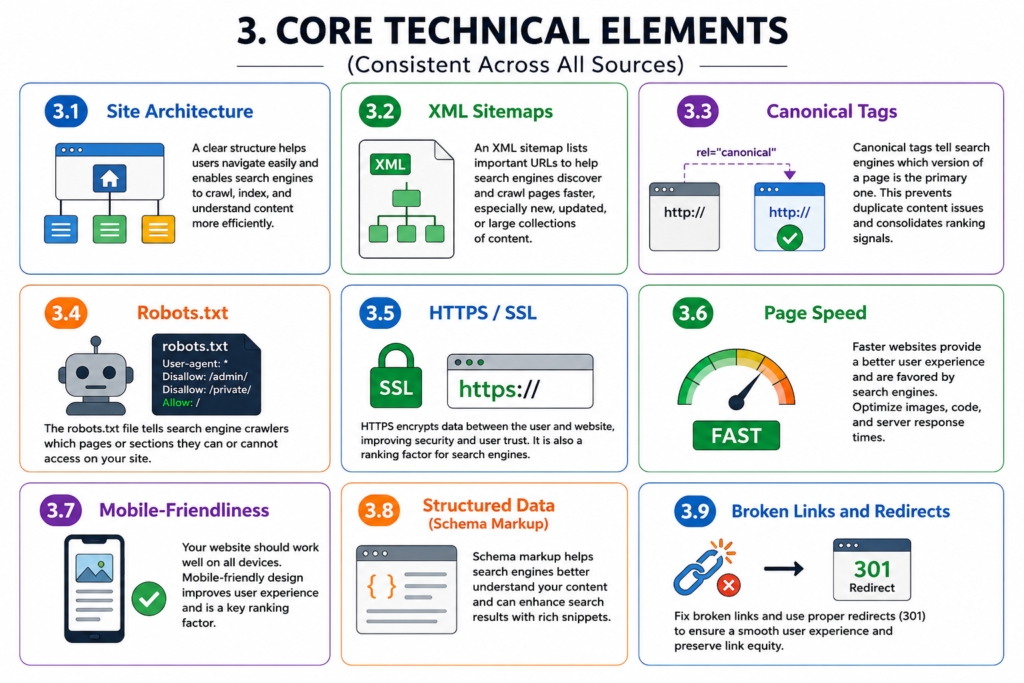
Core Technical Elements (Consistent Across All Sources)
3.1 Site Architecture
A logical hierarchy — ideally keeping every page within two to three clicks of the homepage — improves both crawlability and user navigation. A recurring warning across sources is the danger of orphan pages: pages with no internal links pointing to them, which are difficult or impossible for crawlers to find.
XML Sitemaps
An XML sitemap acts as a roadmap of a site’s important URLs, submitted via Google Search Console. It is especially valuable for:
- Large websites with many pages
- Sites with isolated or newly published pages
- E-commerce platforms with complex category structures
Canonical Tags
When multiple URLs contain similar or identical content, a canonical tag (rel=”canonical”) tells search engines which version is the “original” one to index — consolidating ranking signals and preventing duplicate-content dilution.
Robots.txt
A plain-text file at the site root that instructs bots which sections to crawl and which to avoid. Misconfiguration here is a common and costly mistake — it can accidentally block important pages from ever being crawled.
HTTPS / SSL
Encrypting the connection between browser and server has been a confirmed Google ranking signal since 2014. Beyond rankings, it builds user trust through visible browser security indicators.
Page Speed
Recurring speed-improvement techniques across sources:
- Caching — storing parts of a page so they don’t reload on every visit
- Minification — stripping unnecessary characters from HTML/CSS/JS
- CDN (Content Delivery Network) — serving content from geographically nearer servers
- Image optimization — compression and modern formats (e.g., WebP)
- Lazy loading — deferring offscreen images until needed
Mobile-Friendliness
Because Google uses mobile-first indexing, the mobile version of a site — not the desktop version — is what gets evaluated for ranking. Responsive design, legible font sizes, and adequate spacing around clickable elements are the recurring checklist items.
Structured Data (Schema Markup)
Adding standardized markup (JSON-LD being the most common format) helps search engines understand page content in more granular detail, increasing eligibility for rich snippets — enhanced search results with ratings, images, or event details that improve click-through rates.
Broken Links and Redirects
404 errors and long redirect chains harm both user experience and crawl efficiency. Standard fixes include reinstating deleted pages, using clean 301 redirects, and regularly auditing internal links that point to outdated URLs.
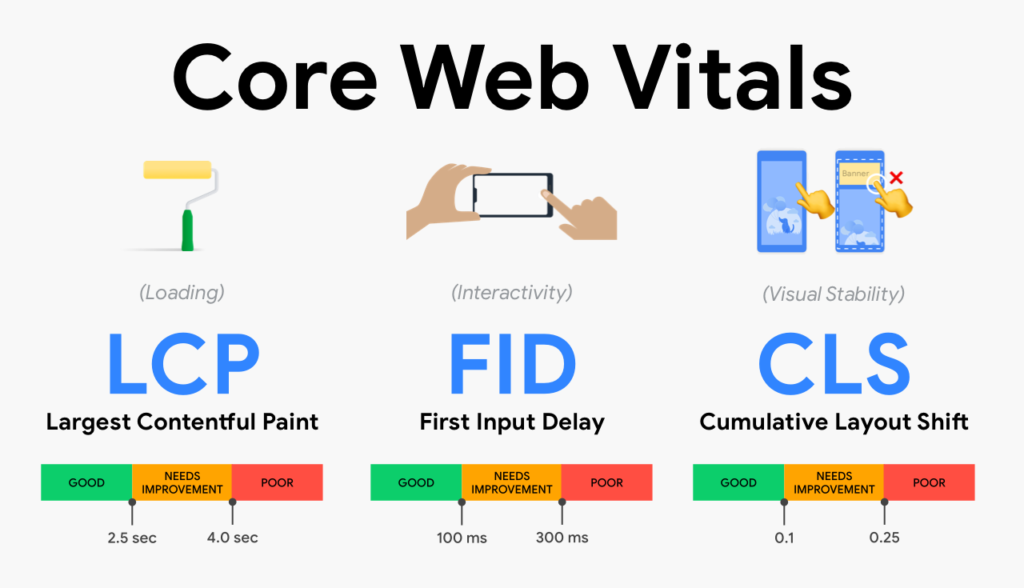
Core Web Vitals — A Point of Notable Discrepancy
All sources treat Core Web Vitals as central to technical SEO, but there is a meaningful inconsistency in how the metrics are defined depending on when each source was written:
| Metric | Measures | Older Sources’ Definition | Updated Definition |
| LCP (Largest Contentful Paint) | Loading performance | ≤ 2.5 seconds | ≤ 2.5 seconds (unchanged) |
| Third metric | Interactivity / Responsiveness | First Input Delay (FID) — under 100ms | Interaction to Next Paint (INP) — under 200ms |
| CLS (Cumulative Layout Shift) | Visual stability | ≤ 0.1 | ≤ 0.1 (unchanged) |
This is worth flagging explicitly: Google officially replaced FID with INP as a Core Web Vital in March 2024. Several of the sources analyzed still reference FID, meaning they reflect pre-2024 guidance. Any technical SEO reference material should be treated with this update in mind — INP is the current standard, not FID.
Areas Where Sources Diverge
Internationalization (Hreflang)
Only some sources cover multilingual/multi-region SEO in depth. Hreflang tags tell search engines which language/region version of a page to serve to a given user. Recommended implementation structures include separate domains (example.fr), subdomains (fr.example.com), or subdirectories (example.com/fr/) — each with its own sitemap submission.
Accessibility (WCAG Compliance)
Only one source treated accessibility as a technical SEO factor rather than a purely ethical/legal one, linking WCAG compliance (alt text, color contrast, transcripts) directly to improved crawlability and indexing — arguing that accessible sites are easier for bots to parse, not just easier for users with disabilities.
E-Commerce-Specific Challenges
One source addressed the unique technical hurdles of large e-commerce sites specifically:
- Managing large volumes of near-duplicate product pages
- Avoiding “crawl traps” created by filters and faceted navigation
- Balancing rich media (product images/videos) against page speed
Additional Best Practices Mentioned Selectively
- Breadcrumb navigation — aids both users and link-equity distribution
- Pagination vs. infinite scroll — infinite scroll can hide content from crawlers that don’t execute all dynamic loading
- Regular technical audit scheduling — treating technical SEO as an ongoing process (weekly/monthly/quarterly), not a one-time fix
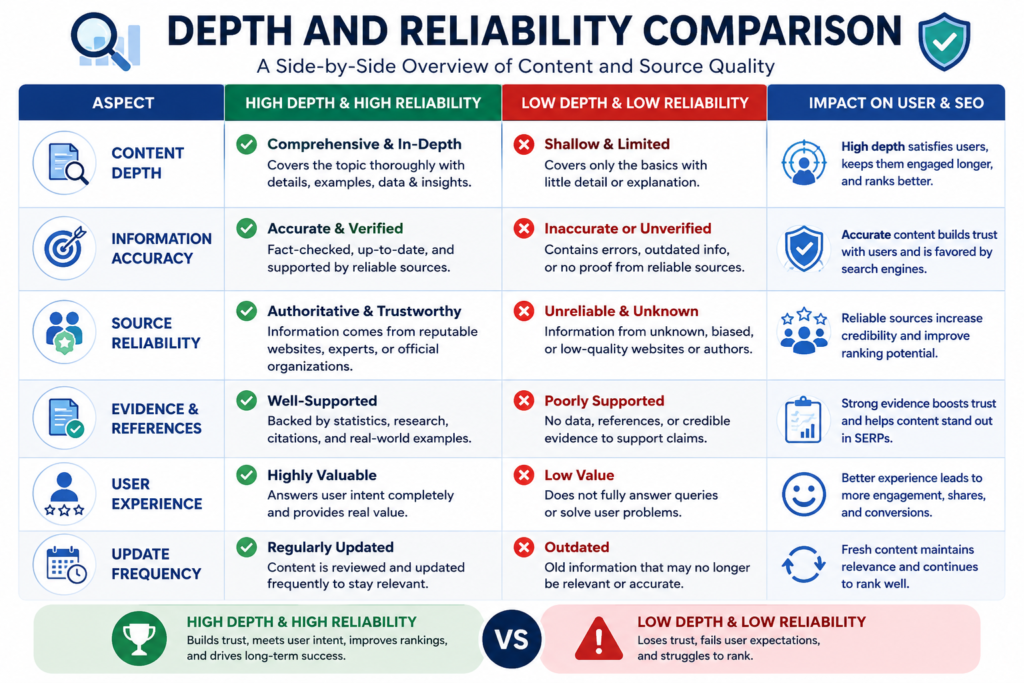
Depth and Reliability Comparison
Ranking the seven sources by depth and technical currency (without naming them individually):
1. Most comprehensive — covered internationalization, e-commerce challenges, and structured audit methodology in addition to the fundamentals.
2. Most technically current — the only one referencing INP instead of FID, and the only one explaining crawl budget in depth.
3. Most tactical/how-to oriented — walked through step-by-step implementation instructions for each fix.
4. Broadest checklist coverage — organized cleanly into components, importance, and benefits, useful as study reference material.
5. Accessibility-inclusive — the only source treating WCAG compliance as part of the technical SEO conversation.
6. Concise academic reference — solid on fundamentals, lighter on advanced or emerging topics.
7. Minimal/thin reference — offered only a brief definition without a detailed best-practices framework.
Key Takeaways
- Technical SEO is the structural foundation that makes content and authority-building efforts effective — not a replacement for either.
- Crawling and indexing are the two processes every technical decision should be evaluated against.
- Core Web Vitals standards have changed — INP has replaced FID as of March 2024; older guides should be read with that correction in mind.
- Crawl budget management is an advanced but increasingly important concept for large or complex sites.
- Site-specific factors — internationalization, accessibility, e-commerce scale — require additional technical considerations beyond the universal checklist.
- Technical SEO is not a one-time project; ongoing audits (monthly to quarterly) are the consistent recommendation across sources for maintaining performance as sites grow and algorithms evolve.
End of document.