

By Lily James, Digital Velocity Nexus (DVN)
The way people find information online has fundamentally changed. Instead of typing a query into a search engine and scrolling through a page of blue links, more and more users are simply asking an AI chatbot — ChatGPT, Claude, Gemini, or Perplexity — and trusting whatever answer comes back. For brands, this shift raises a new and urgent question: when someone asks an AI assistant about your industry, does it mention you? And if it does, does it describe you accurately?
That is the problem LLMO was built to solve.
At Digital Velocity Nexus, we’ve spent the past year helping clients navigate this shift, and this guide lays out everything we’ve learned about what LLMO actually is, how it works, and how to start doing it well.
What Is Large Language Model Optimization?
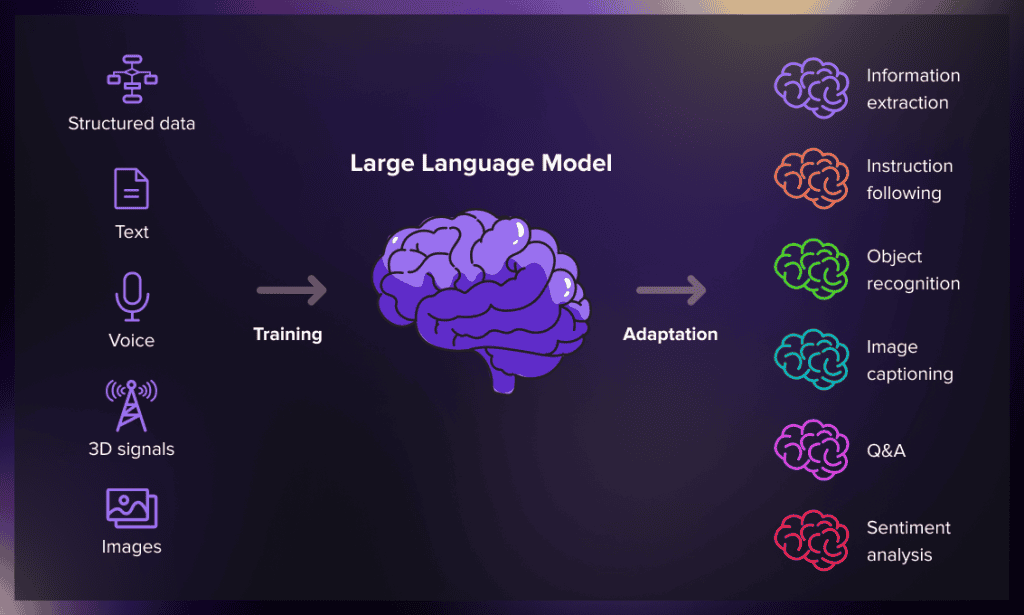
Large Language Model Optimization (LLMO) is the practice of shaping your content, your website, and your brand’s footprint across the web so that AI language models understand who you are, trust what you say, and cite you when generating answers to relevant questions.
Unlike traditional SEO, which is built around ranking in a list of search results, LLMO is built around being the answer — or at least part of it. Success isn’t measured by a blue link and a click. It’s measured by whether an AI system, when asked “What’s the best tool for X?” or “Who are the experts in Y?”, names your brand and describes it accurately and favorably.
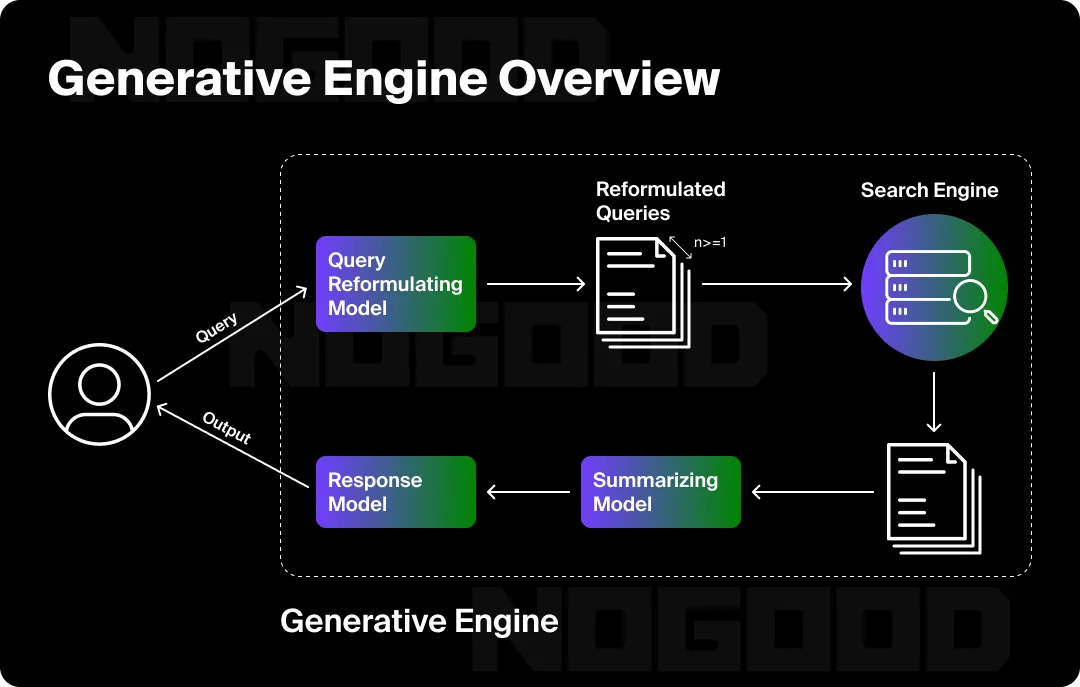
This matters because AI answer engines don’t just summarize the web — they interpret it. They decide which sources are credible, which claims are worth repeating, and which brands deserve a mention. LLMO is how you influence that decision.
Why LLMO Matters Right Now
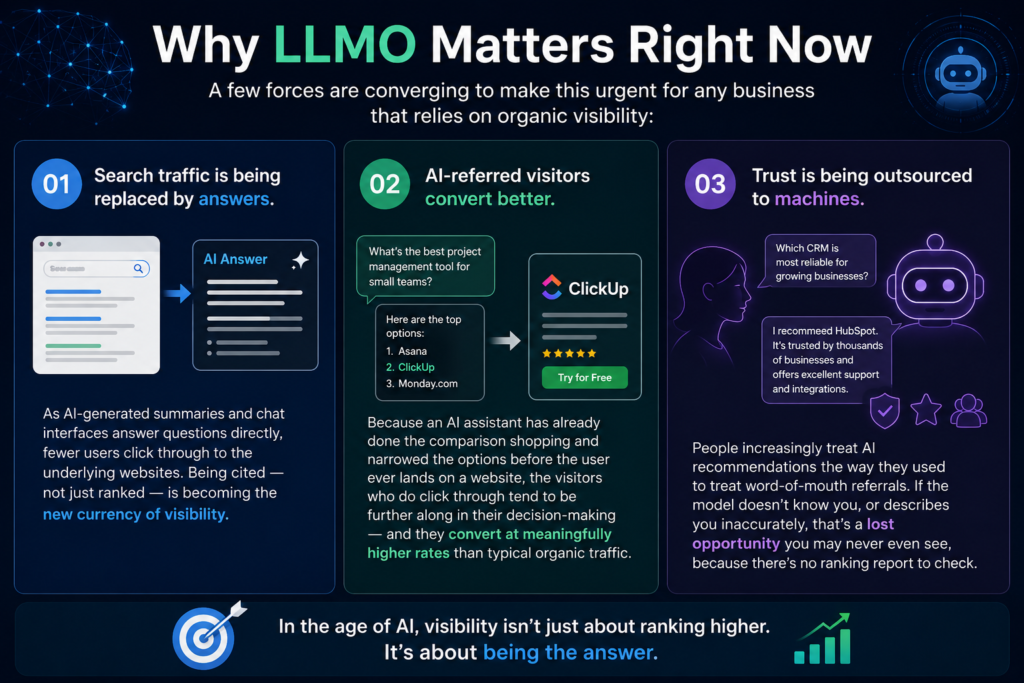
A few forces are converging to make this urgent for any business that relies on organic visibility:
- Search traffic is being replaced by answers. As AI-generated summaries and chat interfaces answer questions directly, fewer users click through to the underlying websites. Being cited — not just ranked — is becoming the new currency of visibility.
- AI-referred visitors convert better. Because an AI assistant has already done the comparison shopping and narrowed the options before the user ever lands on a website, the visitors who do click through tend to be further along in their decision-making — and they convert at meaningfully higher rates than typical organic traffic.
- Trust is being outsourced to machines. People increasingly treat AI recommendations the way they used to treat word-of-mouth referrals. If the model doesn’t know you, or describes you inaccurately, that’s a lost opportunity you may never even see, because there’s no ranking report to check.
How LLMO Differs From SEO, AEO, and GEO
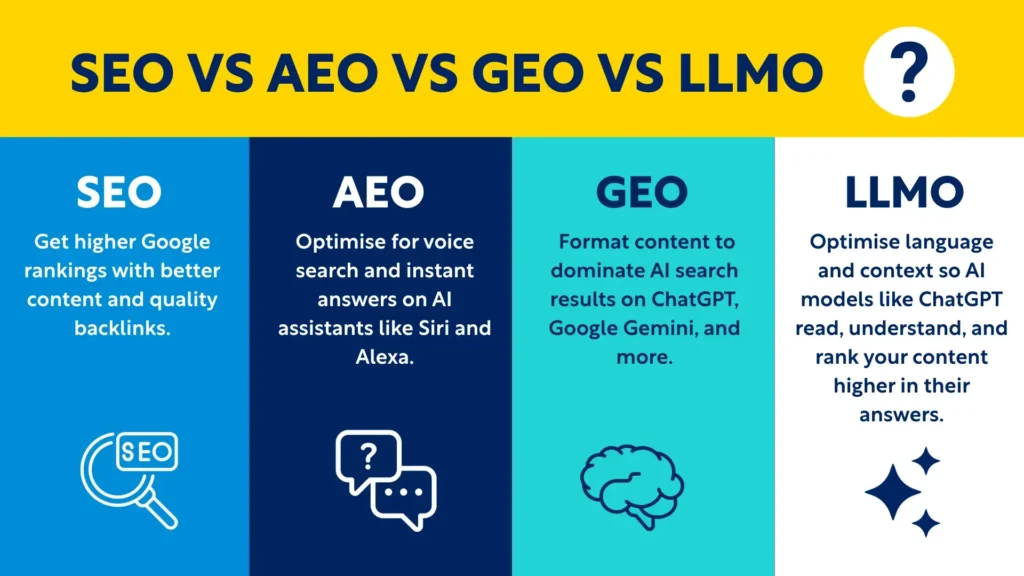
These terms get used interchangeably, but at DVN we find it useful to separate them:
| Approach | What It Targets | The Win |
| SEO | Search engine rankings | A click from a search results page |
| AEO (Answer Engine Optimization) | AI-generated summaries within search (like AI Overviews) | Being the source quoted at the top of the page |
| GEO (Generative Engine Optimization) | Any AI system that generates answers by pulling from the web | Being cited across multiple AI search tools |
| LLMO | The language model itself — how it understands and represents your brand | Being recommended, by name, in a conversational answer |
In practice, these disciplines overlap heavily and reinforce one another. But LLMO is the most brand-centric of the four: it’s less about a single page ranking well and more about whether the model, drawing on everything it has ever encountered about you, has formed an accurate and favorable impression.
The Core Pillars of LLMO
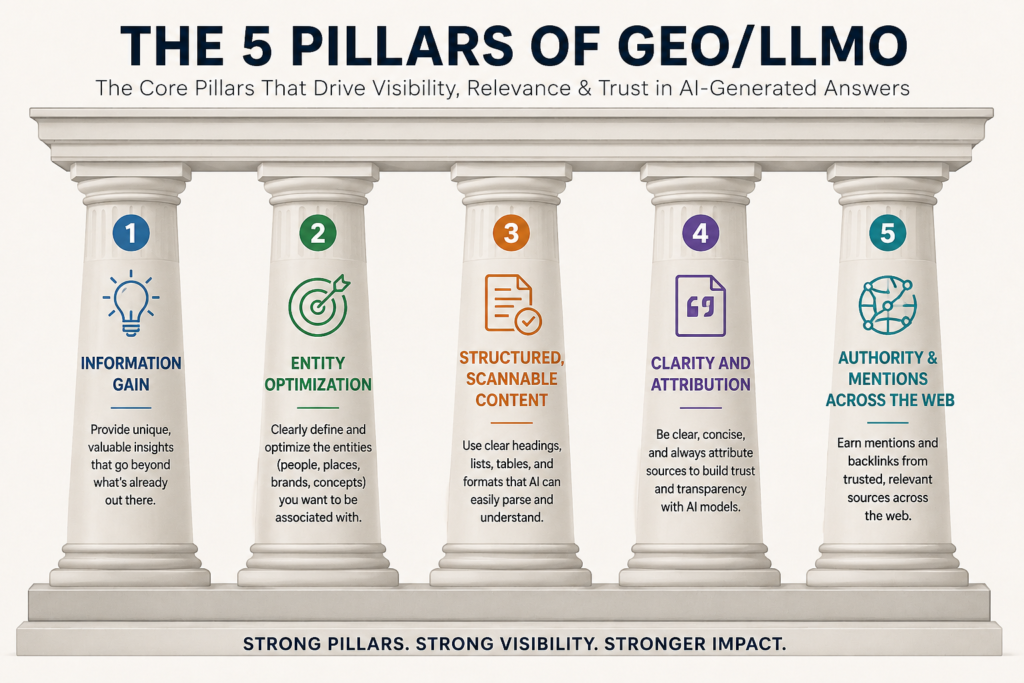
Based on the work we do for clients at DVN, LLMO breaks down into five interconnected pillars.
1. Information Gain
AI models are trained to favor content that adds something new to the conversation, not content that repeats what a hundred other pages already say. If your blog post says the same thing as everyone else’s blog post, there’s no reason for a model to cite you specifically.
What this looks like in practice: – Publishing original data, surveys, or proprietary research – Sharing a genuine point of view or methodology instead of generic advice – Including specific numbers, case studies, and real examples rather than vague claims
2. Entity Optimization
An “entity” is simply how a machine represents a distinct thing — a person, a brand, a product, a concept. Entity optimization is the work of making sure AI systems have a clear, consistent, and complete picture of who you are.
What this looks like in practice: – Using structured data (schema markup) to explicitly label who you are, what you offer, and how your content is organized – Keeping your brand description, positioning, and key facts consistent everywhere they appear — your website, your social profiles, directory listings, and press mentions – Building a presence on platforms that AI systems commonly draw from, so your identity is reinforced from multiple directions rather than depending on your own website alone
3. Structured, Scannable Content
Language models work by extracting and synthesizing specific facts — and they do that far more easily when content is clearly organized. Dense, unbroken paragraphs are harder to mine for a clean, citable answer than content built with headings, lists, and tables.
What this looks like in practice: – Using descriptive, question-style headings that mirror how people actually ask things – Breaking down comparisons into tables rather than paragraphs – Weaving FAQ-style question-and-answer sections throughout a piece, not just tacking them on at the end – Using numbered steps for anything process-based
4. Clarity and Attribution
Models favor content they can quickly verify and trust. That means writing plainly, stating facts directly, and backing claims with credible sources.
What this looks like in practice: – Short, front-loaded paragraphs that lead with the key point – Linking out to credible, authoritative sources to support claims – Avoiding vague or hedge-y language in favor of direct, confident statements
5. Authority and Mentions Across the Web
This is the pillar that surprises people most: a brand’s own website is only one small piece of how an AI model forms its opinion of that brand. Models absorb information from reviews, forums, press coverage, industry publications, and countless third-party sources. The aggregate of all of that — not just your own copy — is what shapes how confidently a model recommends you.
What this looks like in practice: – Earning coverage and mentions on respected industry sites and publications – Participating authentically in relevant online communities and discussion forums – Being included in “best of” and comparison-style content that AI systems frequently draw from – Monitoring and responding to how your brand is discussed publicly, since reputation directly shapes how a model describes you
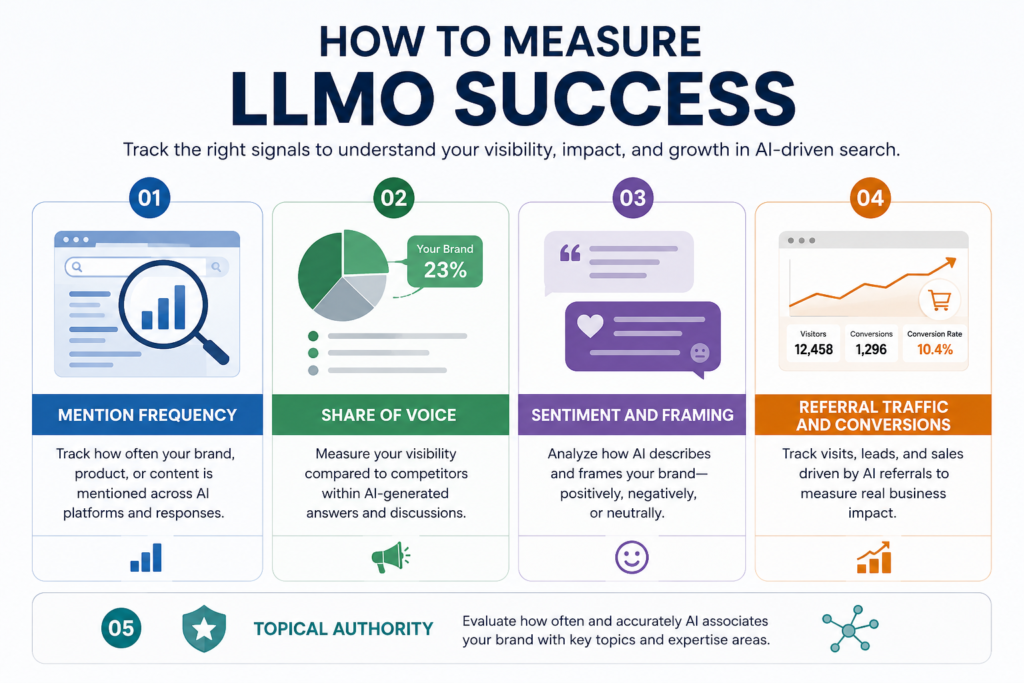
How to Measure LLMO Success
Because there’s no familiar “rank #3” report for AI chat responses, measurement looks different. At DVN, we track:
- Mention frequency — how often your brand comes up when relevant questions are asked across major AI platforms
- Share of voice — how your mention rate compares to competitors in your space
- Sentiment and framing — whether the model describes you positively, neutrally, or with outdated or inaccurate information
- Referral traffic and conversions — the visitors who do click through from AI platforms, and how they behave once they arrive
- Topical authority — the breadth of subjects where a model treats your brand as a credible source, and whether that breadth is growing over time
Getting Started: A Practical Checklist
If you’re beginning an LLMO effort, here’s where DVN recommends starting:
- ☐ Ask major AI platforms directly what they know about your brand, and document the gaps or inaccuracies
- ☐ Add structured data (schema markup) across your key pages
- ☐ Audit your content for repetitive, low-value pages and replace them with original, well-supported material
- ☐ Restructure key pages with clear headings, lists, and comparison tables
- ☐ Build a deliberate plan for earning mentions on respected third-party sites in your industry
- ☐ Keep your brand description and key facts consistent across every platform where you appear
- ☐ Revisit and repeat this process regularly — this is an evolving landscape, not a one-time fix

Final Thoughts
LLMO isn’t a replacement for good content strategy — it’s an extension of it, built for a world where the first (and sometimes only) impression a potential customer gets of your brand comes from a conversation with an AI, not a search results page. The brands that invest now in being clear, consistent, and genuinely useful across the web will be the ones AI systems reach for when it matters.
This guide was written by Lily James for Digital Velocity Nexus (DVN).