
Everything marketers and content creators need to know about ranking in ChatGPT, Perplexity, Gemini, and Google AI Overviews — not just Google’s blue links.

Introduction
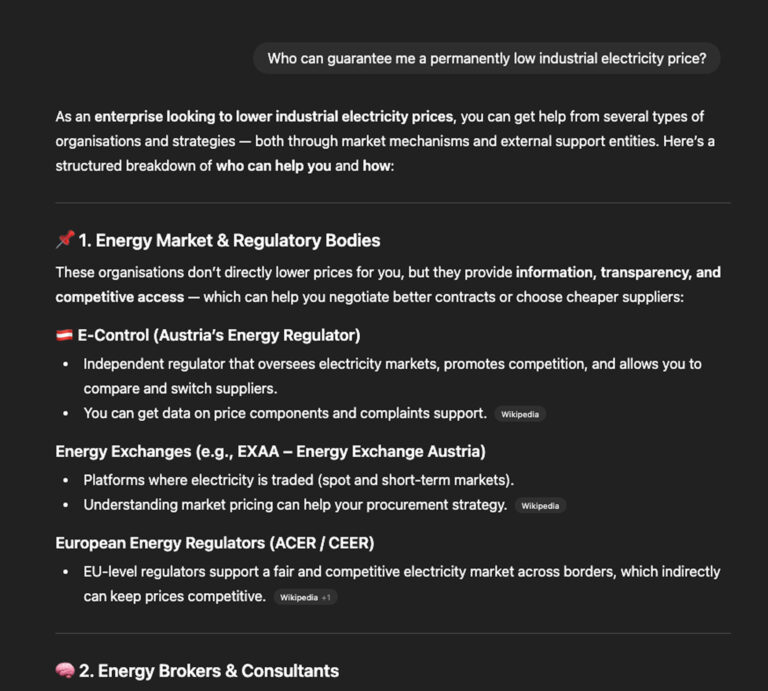
Search doesn’t look the way it did three years ago, and honestly, it doesn’t even look the way it did last year. People are typing full questions into ChatGPT instead of three keywords into Google. They’re asking Perplexity to compare products for them instead of opening ten tabs. And when they do use Google, an AI-generated summary is often sitting right at the top of the page, answering their question before they scroll any further.
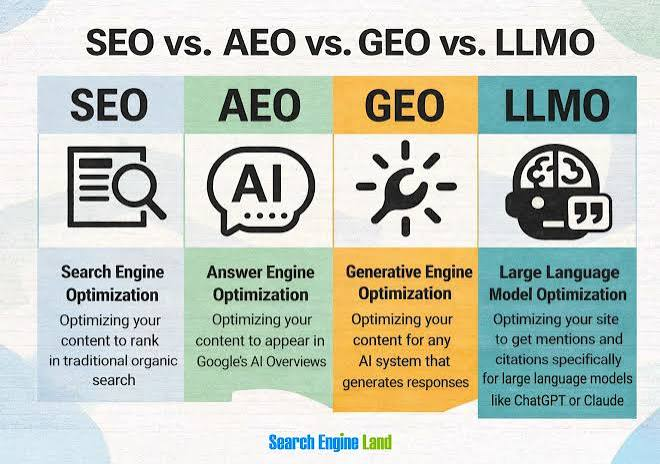
That shift has forced a new discipline into existence: Generative Engine Optimization, or GEO. If you’ve been in marketing for more than five minutes, you’ve probably already heard the term thrown around — sometimes interchangeably with AEO (answer engine optimization) or AIO (AI optimization). This guide, put together by the team at Digital Velocity Nexus (DVN), breaks down what GEO actually is, why it exists, how it’s different from traditional SEO, and what you can realistically do about it.

What Is Generative Engine Optimization?
At its core, GEO is the practice of shaping your content, your site structure, and your broader digital footprint so that AI systems — ChatGPT, Gemini, Claude, Perplexity, and AI-powered search features — are more likely to reference, summarize, or cite you when answering a user’s question.
It’s a fairly new term. According to Wikipedia’s entry on the subject, GEO emerged specifically as generative AI tools became embedded into mainstream search and information-retrieval experiences, and it’s already picked up several aliases in the industry — AEO, AIO, AI SEO, and LLMO (large language model optimization) all describe roughly the same idea, even if practitioners argue about the nuances.
Put simply: GEO is about structuring content so AI-driven engines can accurately analyze and summarize it, which keeps your brand visible even in an environment where fewer people are clicking through to actual websites.
That last part matters more than it might seem. When an AI Overview shows up on a Google results page, the click-through rate for the top organic result drops significantly — industry research from Ahrefs put the early drop at around 34.5%, and more recent data pushes that number closer to 58%. ChatGPT itself now processes billions of prompts a day, a large share of which function as search queries, and its click-through rate to outside websites is dramatically lower than Google’s ever was. People are getting their answers without ever landing on a website — which is exactly the environment GEO is built for.
How Is GEO Different From SEO?
This is the question everyone asks first, and the honest answer is: GEO builds on SEO rather than replacing it.
Traditional SEO is about ranking — getting your page to the top of a results list through keywords, backlinks, site speed, and user behavior signals. Think of it like a card-catalog system: you use the right codes so a “librarian” (the search engine) knows where to point people.
GEO, on the other hand, is closer to having an actual conversation with that librarian. You’re not just marking where your content lives — you’re explaining what it’s about, why it’s trustworthy, and how it directly answers the question being asked. The goal isn’t a ranking position anymore; it’s becoming part of the answer itself.
There’s also research suggesting GEO isn’t really a separate discipline so much as an extension of SEO. The same authority signals that help you rank well in Google — quality backlinks, brand mentions, structured content, topical depth — also influence whether an LLM decides to reference you. One industry study found a meaningful correlation (roughly 0.65) between strong page-one Google rankings and being mentioned by LLMs. Correlation isn’t causation, but it’s a strong enough signal that ignoring your SEO fundamentals in favor of “AI hacks” would be a mistake.
Where the two genuinely diverge is in what success looks like. SEO metrics — rankings, click-through rate, monthly search volume — largely stop being reliable in a GEO context. There’s no stable “position” in an AI answer. Ask the same question five minutes apart and you might get a different set of cited sources. That’s a real headache for anyone used to reporting neat ranking charts to a client.
How Do AI Engines Actually Decide What to Cite?
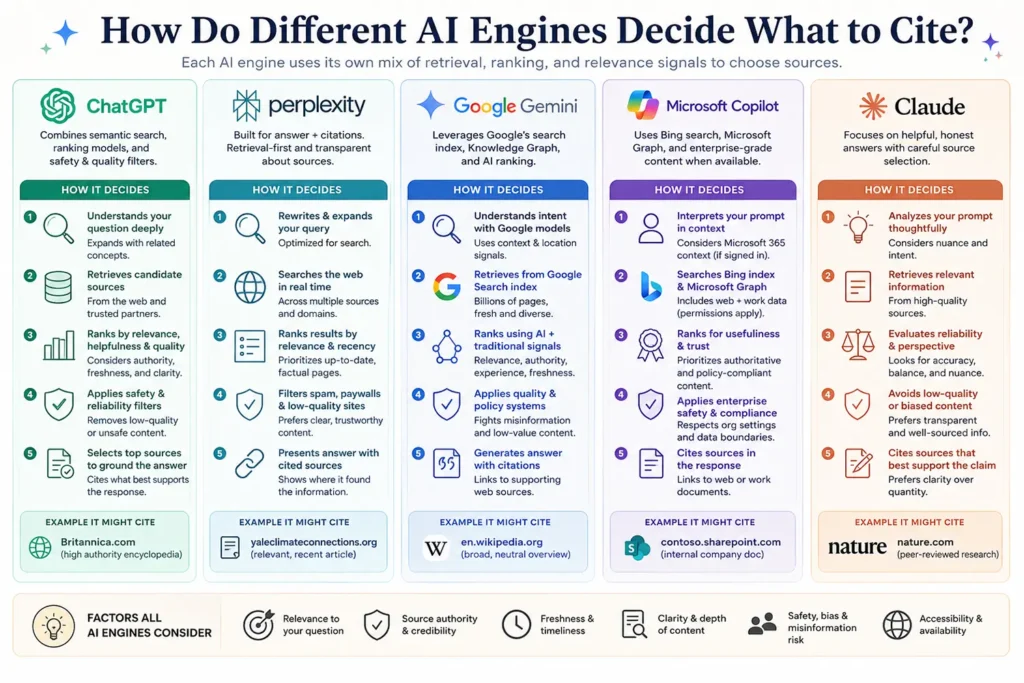
To optimize for something, it helps to understand how it works under the hood — and this is where a lot of GEO advice gets vague. A useful way to think about it is that generative engines fall into three rough categories.
Training-Based Systems
Models like Claude, when they’re not actively searching, answer from what they learned during training. You can only influence these indirectly, over time, by building a consistent presence across platforms that end up feeding into future training data — think Wikipedia, Reddit, and reputable media coverage.
Search-Based Systems
Engines like Perplexity or Google’s AI Overviews pull from live web indexes in real time, closer to how a normal search engine works. Classic SEO fundamentals carry real weight here.
Hybrid Systems
Tools like Gemini or ChatGPT with browsing enabled blend both — foundational knowledge from training, current specifics from the web.
Retrieval-Augmented Generation (RAG)
Instead of relying purely on frozen training data, RAG lets a model pull in fresh, external documents at the moment someone asks a question, breaking that content into indexed, retrievable chunks. Wikipedia’s entry on GEO notes that this shift is a big part of why the whole discipline exists in the first place — it moved the goalposts from page-level ranking toward how retrievable and well-structured your content is within these vector-based knowledge systems.
One detail worth knowing: models don’t always bother searching the web at all. A leaked look at Claude’s system behavior showed that Claude, by default, answers from its own internal knowledge unless a question is time-sensitive, requires multiple perspectives, or clearly falls outside what it already “knows.” That’s an important nuance — if your content covers a stable, encyclopedic topic that a model can already answer from memory, you probably won’t see much referral traffic from it, no matter how well-optimized it is. Visibility tends to concentrate around content that’s specific, current, or genuinely hard to answer from memory alone — original research, live pricing, comparison data, firsthand experience.
Practical Best Practices for GEO
Pulling together what current industry research converges on, a few practices show up again and again.
1. Write for the Question, Not the Keyword
Instead of optimizing around a fragment like “best running shoes,” think about the full, natural question someone would actually type or speak to an AI assistant — “which running shoes are best for a beginner training for their first marathon?” Long-tail, conversational phrasing tends to match how people actually prompt these tools.
2. Answer First, Explain Second
If a heading asks a question, the very next sentence should answer it directly. AI systems — and honestly, most human readers too — don’t want three paragraphs of throat-clearing before the actual point.
3. Structure Content So It’s Easy to Lift
Clear H2/H3 hierarchies, bullet points, comparison tables, and FAQ sections all make it dramatically easier for a model to extract a clean, quotable chunk of your content. This is often called “scannability,” and it applies to both AI systems and impatient human readers.
4. Back Claims With Real Evidence
Original research, verifiable statistics, and expert quotes get cited more often than unsupported opinions. AI models — much like careful human readers — gravitate toward content that shows its work.
5. Make Authorship and Freshness Visible
A visible “last updated” date, clear author credentials, and proper citations all function as trust signals. Industry data has found that a striking share of AI-driven traffic goes to pages updated within the last two years — barely any goes to content older than four.
6. Don’t Neglect the Technical Layer
Schema markup (Article, FAQPage, HowTo), a crawlable site (allowing bots like GPTBot), and solid page performance are described across nearly every source here as the “boring but essential” foundation GEO sits on top of.
7. Build Presence Beyond Your Own Website
Several of these guides point out that platforms like Reddit, YouTube, and LinkedIn are frequently cited by AI engines — sometimes more than brand websites themselves. A narrow focus on your own domain misses a big part of the picture.
The Benefits — and the Real Challenges
GEO isn’t a magic bullet, and the sources here are refreshingly honest about that.
The Upside
Brands that show up consistently in AI-generated answers tend to build trust and recognition even without a click, and early movers are essentially staking a claim in a channel that’s still being figured out. There’s also a compelling economic angle — data from Semrush shows visitors referred from LLMs convert noticeably better than typical search traffic, since by the time someone reaches your site through an AI-mediated journey, they’ve often already done a lot of their decision-making.
The Downside
There’s real uncertainty baked into this space. AI companies don’t publish their exact citation logic, so a lot of GEO practice is still educated guesswork validated through testing rather than a documented rulebook. Algorithms and models change constantly — what worked for citation rates six months ago might not hold today. And because these systems synthesize information from multiple sources at once, there’s a genuine risk of your content being paraphrased slightly out of context, which matters a great deal in sensitive fields like healthcare or finance.
How Do You Even Measure Success?
This might be the hardest part of GEO right now, because the old scoreboard doesn’t really work anymore.
One useful way to think about it is a simple three-part framework:
- Be Seen — Are you showing up when AI tools answer questions in your category at all?
- Be Believed — Is the AI representing your brand accurately?
- Be Chosen — Is any of this actually translating into business outcomes?
Instead of chasing a keyword ranking, you’re tracking things like how often your brand gets mentioned across a set of representative prompts, how accurately that mention reflects reality, and whether people referred by AI tools are converting.
Tools like Ahrefs, Semrush, Profound, Scrunch, and Similarweb (all mentioned in Wikipedia’s overview of the space) have built out dashboards specifically to monitor this — tracking citation frequency, sentiment, and share of voice across ChatGPT, Gemini, and Perplexity. Google’s own Search Console-style tools are also starting to surface how often a site appears inside AI Overviews.
Should You Actually Invest in This Right Now?
Probably, yes — but with a sense of proportion. A common rule of thumb in the industry: if your SEO foundation is already strong, put an extra 20–25% of that budget toward GEO experimentation. If your SEO still needs basic work, fix that first, because GEO is built directly on top of it, not instead of it.
None of the sources reviewed here suggest that GEO makes SEO, content marketing, or digital PR obsolete. If anything, they all seem to agree on the opposite: those disciplines are the foundation everything else stands on. What’s changed is the destination. You’re no longer just trying to earn a spot on a results page — you’re trying to earn a spot inside the answer itself.
Quick Summary
- GEO is the practice of optimizing content so AI systems cite, summarize, or reference it — not just so it ranks in traditional search.
- It builds on SEO rather than replacing it; the same authority and quality signals still matter, just applied differently.
- AI Overviews and chat-based search are already cutting into click-through rates significantly, which is exactly why GEO has become urgent.
- Good GEO content answers questions directly, is clearly structured, backs claims with real data, and stays current.
- Success looks different here — think visibility and citation accuracy, not rankings and CTR.
- This is still an evolving field with no universal playbook, so ongoing testing matters more than any single tactic.
This guide was researched and written by Arfa for Digital Velocity Nexus (DVN), drawing on an analysis of current industry research and publicly available data on AI search behavior, current as of mid-2026. For GEO strategy and AI search visibility support, reach out to the DVN team.